

International roaming charges have a way of turning a dream trip into a financial shock. Most travelers don’t notice the problem until they get home and open their phone bill. At FIFA 2026 — a tournament spread across three countries, 16 cities, and six weeks of football — the exposure is greater than for almost any previous World Cup.
The good news is that avoiding roaming charges is entirely straightforward if you plan ahead. This guide explains how roaming works, why FIFA 2026 makes it especially risky, and what your options are for staying connected without a nasty bill at the end.

What Are Roaming Charges and How Do They Work?
When you use your smartphone abroad, your phone connects to a local network in the country you’re visiting. Your home carrier pays that local network to handle the connection, and passes the cost on to you — plus a markup. This is called roaming.
Roaming charges can apply to calls, texts, and data. Data is typically where the damage is done. Using Google Maps in an unfamiliar city, checking your match tickets in the FIFA app, uploading photos to social media, or streaming a pre-match show can burn through data quickly — and at roaming rates, each gigabyte can cost many times what you’d pay at home.
Many carriers now offer daily or weekly travel passes that cap your costs to a fixed daily fee. These are an improvement on standard roaming, but they tend to be expensive over a multi-week trip, they often only cover one country at a time, and the data allowances can be stingy.
Why FIFA 2026 Is a Particularly High-Risk Roaming Situation
Most international trips involve one country, one currency, and one set of roaming rules. FIFA 2026 is different in several important ways:
• Three host countries. The USA, Canada, and Mexico each have their own mobile networks and their own roaming agreements with international carriers. If your carrier’s travel pass only covers one of the three, you’re exposed the moment you cross a border.
• Weeks away, not days. Even a modest daily roaming fee adds up quickly over a three- or four-week trip. At £10 per day, a 21-day trip costs over £200 in roaming fees alone
• Heavy data usage. A World Cup trip involves near-constant use of your phone: navigating unfamiliar cities, managing digital tickets, staying in touch with your group, translating menus in Mexico, and sharing the moments as they happen. You’ll use more data than on a typical holiday.
• Border crossings. If you’re following a team across multiple venues, you may cross between host countries more than once. Each crossing can mean a different roaming rate, and your carrier’s app may not tell you this in advance.
Your Four Options: A Comparison
Here’s how the main approaches to staying connected at FIFA 2026 compare:
| Option | Cost | Multi-country | Setup effort |
|---|---|---|---|
| Home carrier roaming | Very high | Yes, but expensive | None |
| Local SIM per country | Moderate | 3 SIMs needed | High |
| Carrier travel add-on | Moderate-high | Usually one country | Low |
| BNESIM North America eSIM | Best value | Yes — all 3 countries | Very low |
The table above makes the decision fairly clear. For a single-country trip of a few days, a carrier travel add-on is perfectly manageable. For a multi-country World Cup trip, it falls short.
The Right Solution: BNESIM’s North America Regional eSIM
An eSIM is a digital SIM card built into your phone. Instead of inserting a physical chip, you download a data plan via a QR code — usually in under five minutes — and it’s active before you leave home.
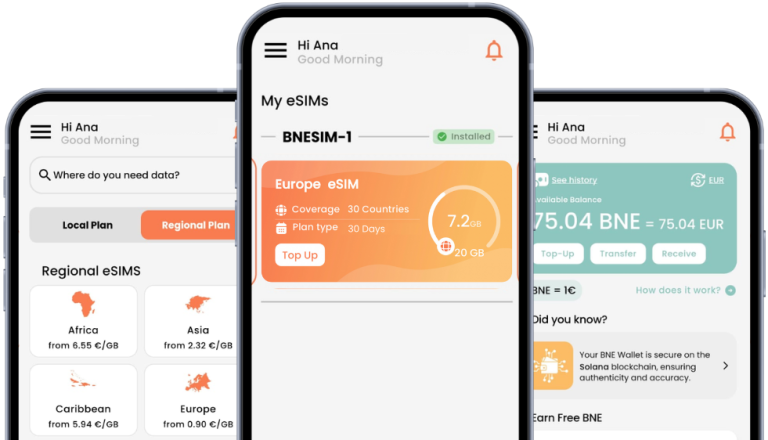
BNESIM’s North America Regional eSIM is designed specifically for this type of trip. It covers the USA, Canada, and Mexico on a single plan — one activation, one price, no border switching required. Your data works seamlessly from the moment you land in your first host city to the moment you leave the last one.
Unlike your home carrier’s travel add-on, the BNESIM eSIM isn’t subject to per-day roaming fees. You pay for your plan once, and you know exactly what you’re getting. No surprises, no daily charges ticking up while you sleep.
Additional Tips to Keep Your Data Usage in Check
Even with a generous data plan, a few habits will help you get the most out of your allowance during a long trip:
• Download offline maps before you leave. Google Maps and Apple Maps both allow you to save specific areas for offline use. Download maps for each host city before you arrive — you’ll use far less data navigating.
• Pre-download content at your hotel. If you want to watch match highlights or pre-match build-up, download them on Wi-Fi rather than streaming on mobile data.
• Turn off background app refresh. Many apps refresh in the background and consume data without you knowing. Go to your phone’s settings and disable this for any apps you don’t need updating continuously.
• Use WhatsApp or iMessage over Wi-Fi where possible. Most stadiums, hotels, and airport lounges offer free Wi-Fi. Messaging and calling over Wi-Fi uses no mobile data.
• Check your data usage regularly. The BNESIM app lets you monitor your usage in real time so you can manage your plan throughout the trip.
The Bottom Line
Roaming charges are one of the most avoidable costs of international travel — and at FIFA 2026, where three countries are involved and the trip could last several weeks, they’re one of the most significant. The simplest and most cost-effective solution is a travel eSIM that covers all three host countries on a single plan.
The BNESIM North America Regional eSIM removes the roaming problem entirely. Set it up before you fly, and your connectivity is sorted from day one — without daily fees, border surprises, or a bill waiting for you when you get home.



 English
  Italiano