
Flying to the United States, Canada, or Mexico for the FIFA World Cup 2026 is going to be a trip to remember. Whether you’re attending a single match or following your team across multiple venues, getting connected is one of the first practical things to sort — and it’s simpler than many first-time visitors to North America expect.
Before you go, BNESIM has a FIFA 2026 offer built for exactly this trip — covering all three host countries on one prepaid eSIM North America FIFA 2026 plan, activated before you leave home.
Your Three Options for Getting Online in North America
When you arrive in a new country, there are three main ways to get mobile data. Here’s how each one works for a FIFA 2026 trip:
Option 1: Roaming on Your Home SIM
The easiest option from a setup perspective — your phone works the moment you land, on your existing number. But international roaming data rates are expensive, and most home carriers charge per country. At FIFA 2026, where three host countries are involved and the tournament runs for weeks, roaming through your home carrier can result in a very large bill.
Many carriers offer daily or weekly travel packages — a fixed fee per day for a capped data allowance. These help, but they still add up over a long trip and often only apply to one country at a time. Crossing from Mexico into the USA or from the USA into Canada can mean a new daily charge begins.
Option 2: Buy a Local SIM Card on Arrival
Local prepaid SIM cards in North America offer good value for data within a single country. In the USA, carriers like T-Mobile and AT&T sell prepaid tourist SIM cards at airports and phone shops. Canada has options through Rogers, Bell, and Telus. Mexico is dominated by Telcel, with widely available prepaid SIM cards in cities.
The challenge for FIFA 2026 is that local SIM cards are country-specific. A US prepaid SIM won’t give you local rates in Mexico, and a Mexican SIM won’t cover you when you cross into the USA. For tourists visiting only one host country, a local SIM is a reasonable option. For multi-country trips, you’re back to buying multiple SIMs and managing the swaps.
Option 3: BNESIM North America Regional eSIM (Recommended)
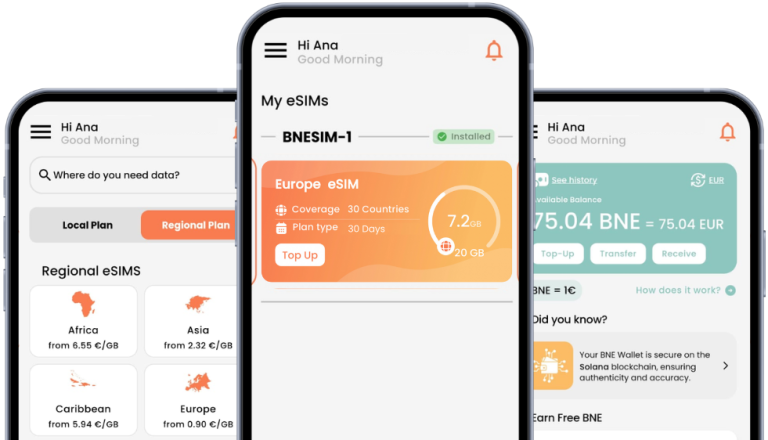
An eSIM is a digital SIM built into your phone — no physical card required. You download a data plan via a QR code or app before you travel, and it’s active before you land. BNESIM’s North America Regional eSIM covers the USA, Canada, and Mexico on one plan, making it the only option that handles all three host countries without any extra steps.
For tourists visiting North America for FIFA 2026, the BNESIM eSIM removes every connectivity complication. There’s no phone shop to find, no language barrier in Mexico, no risk of your data stopping at a border, and no surprise charges at the end of the trip.
What Makes Getting Online in North America Different
If this is your first visit to the United States, Canada, or Mexico, a few things are worth knowing about how connectivity works there:
• Your phone must be unlocked. If your device is tied to your home carrier (locked), it cannot use a different SIM or eSIM. Check with your carrier before you travel — unlocking a fully paid-off phone is usually free.
• US and Canadian networks use compatible frequency bands with most modern smartphones. Devices sold in Europe, Asia, and Australasia from 2019 onwards generally work without issues.
• Mexico is primarily covered by Telcel, with strong 4G coverage in all three host cities (Guadalajara, Mexico City, Monterrey). In smaller towns outside the match venues, coverage can thin out.
• Wi-Fi is widely available in hotels, airports, and most cafes and restaurants across all host countries. But for navigating in real time, accessing match tickets, and keeping in touch with your group, you need reliable mobile data — not just Wi-Fi when you happen to find it.
How to Set Up the BNESIM eSIM Before You Go
Getting connected with the BNESIM North America Regional eSIM takes about five minutes:
1. Confirm your phone is eSIM-compatible device and unlocked. Most smartphones released after 2019 support eSIM — iPhone XS and later, Samsung Galaxy S20 and later, Google Pixel 3 and later.
2. Visit BNESIM and select the North America Regional FIFA 2026 plan. Complete your purchase online.
3. You’ll receive a QR code. On your phone, go to Settings > Mobile/Cellular > Add eSIM and scan it.
4. The BNESIM eSIM profile downloads in about 30 seconds. Set it as your active data line in settings.
5. Test your connection at home before you travel. You’re ready.
When you land in your first host city — whether that’s Miami, Toronto, or Guadalajara — your data is already working. No queues, no shops, no complications.
Frequently Asked Questions
Can I keep using my home number for calls and texts?
Yes. When you add the BNESIM eSIM as a second line, your home SIM stays active for calls and texts. The BNESIM eSIM handles all your mobile data. You can have both running simultaneously on any dual-SIM capable device.
Will the BNESIM eSIM work in all 16 FIFA 2026 host cities?
Yes. The North America Regional plan covers mobile networks across the USA, Canada, and Mexico — including all 16 host cities. Coverage quality reflects the local network infrastructure in each city, which is excellent in all host city locations.
What if I only visit one host country?
The BNESIM North America Regional eSIM works just as well for a single-country visit. If you’re only attending matches in the USA, for instance, the plan covers you throughout your trip — and if your itinerary changes and you decide to cross into Canada or Mexico, you’re already covered.
The Simple Answer
Getting online when visiting North America for FIFA 2026 doesn’t need to be complicated. For tourists who want to be connected from the moment they land — across all three host countries, without daily roaming fees or phone shop queues — the BNESIM North America Regional eSIM is the clearest solution available.
Set it up at home, test it before you fly, and focus on the football.
Ready to get online before you fly?


 English
  Italiano